

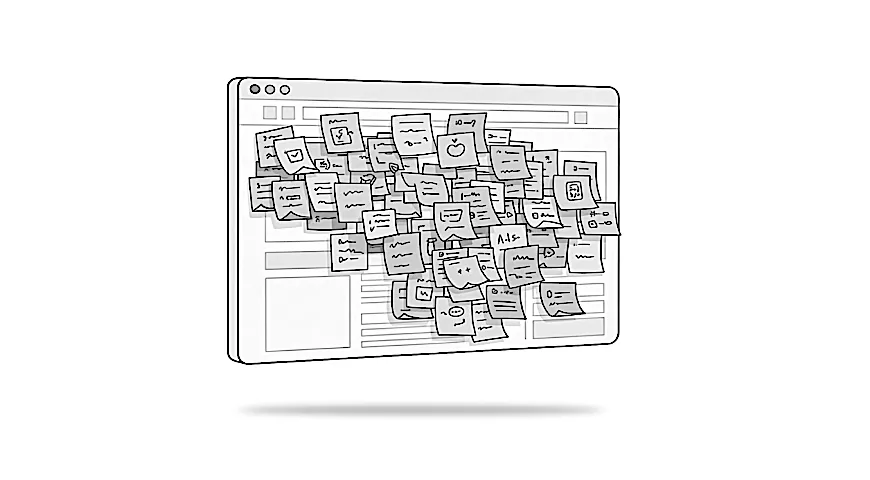
Websites rarely become complicated all at once. More often, they become harder to work with through a long trail of sensible decisions made over months or years.
Each change solves something in the moment, but over time the layers begin to show. This article explains why that happens and what it usually means for long-term manageability.
Why this happens more often than people expect
Most websites grow organically rather than through a planned roadmap. A new page is added here, a feature is bolted on there, and a few design tweaks happen whenever something needs refreshing. Individually, these changes make perfect sense. Together, they gradually reshape the site into something more complex than it first appears.
Small additions accumulate quietly. A plugin introduced years ago for a simple task still sits in the background even though the business now works differently. Old styling choices remain in place while new ones sit on top.
A page layout built in one tool sits next to a newer page built in another. Nothing is broken, but the structure becomes uneven in ways that only reveal themselves later, much like the way email issues building up can surface only after months of small shifts.
Most complexity comes from small, sensible decisions made over time, not from anything dramatic happening all at once.

A practical resource where I explain how to think clearly about your website, so it feels easier to manage and better aligned with the way your business actually works.
How these changes usually show up day to day
The first sign is often inconsistency. Two pages that should look similar behave differently. A form works one way in one part of the site but has a different setup elsewhere. Updating content takes longer because each section seems to follow its own rules.
Over time, this inconsistency creates hesitation. Editing feels less predictable, and the person managing the site can’t always remember how something was originally created.
Tasks that were once straightforward require more thought, simply because the path through the site is no longer uniform. It’s often at this stage that you start to feel the structure is holding things back, even if the symptoms appear small on the surface.
Patterns that tend to create long-term complexity
Certain patterns appear again and again in websites that have evolved over several years. One of the most common is mixing tools. A site may start with one theme or builder, then adopt another for a new project, and eventually end up with a patchwork of approaches. Each part works, but they don’t work in the same way.
Layers of design choices also add weight. Colours, buttons, and layouts introduced at different stages result in a site that feels slightly different from section to section.
Content reorganised several times may leave behind unused templates or hidden elements that still influence how the site behaves.
Plugins follow a similar path. A plugin added for a small feature might later overlap with another introduced for a different need. These overlaps aren’t always visible, but they contribute to the sense that the site has become harder to understand.
Sites that feel this way often benefit from moving closer to maintainable builds, where the structure is simpler and the tools are more consistent.
Why the site starts feeling harder to update
At some point, the site no longer feels predictable. Someone managing it might hesitate before making changes because they’re not sure how different parts are connected. A simple update takes longer because it involves navigating older decisions. Even if nothing is visibly wrong, the mental load increases.
This is where the experience becomes frustrating. The website technically works, but it feels fragile. Editing requires extra care, not because the person is doing anything wrong, but because the structure has become a mixture of old and new ideas.
The fear of breaking something, even unintentionally, adds pressure to tasks that should feel routine. This is also why it helps to avoid places where a small change can take the site down quickly, such as editing live files inside the WordPress admin.
A site can work perfectly on the surface while feeling fragile underneath, simply because its structure has been shaped by years of mixed decisions.
What usually needs attention to bring clarity back
Clarity often returns when the underlying structure of the site is reviewed with fresh eyes. This doesn’t mean rebuilding everything. It simply means understanding how the different parts relate to each other and deciding which areas now create friction.
Sometimes the design layers need to be simplified so the site feels coherent again. In other cases, outdated plugins or overlapping tools are where the heaviness sits.
Occasionally the content structure has drifted so much that reorganising it brings immediate relief. These are typical areas that benefit from thoughtful attention when a site has evolved over several years.
When you don’t need to manage this alone
A developer can help make sense of how the site reached its current shape. They can look at the mix of tools, old decisions, and hidden elements that often sit beneath the surface.
This isn’t about fixing something specific. It’s about understanding the full picture and identifying where simplification brings the most value.
For many small businesses, the benefit is clarity, knowing whether the site can be gently improved or whether a light rebuild would create a cleaner, easier foundation. It’s a collaborative process, not a technical deep dive, and it often brings a sense of relief.
A calmer way forward
If your site feels messy or heavier to manage than it used to, it’s a common situation rather than a mistake. Small changes over time naturally build up, and sometimes a fresh perspective helps everything make more sense.
If your site now feels tangled or difficult to work with after years of small changes, my Build and Enhance service explains how a fresh, modern foundation can make everything feel clearer and easier to manage.