

Towards the end of each year, I notice the same kind of posts appearing.
Summaries of growth.
Lists of achievements.
Clear lines between where someone started and where they ended up.
This isn’t one of those posts.
Not because there’s nothing to say, but because this year felt less about progress and more about paying closer attention.
Refocusing rather than starting again
Over the past year, I spent time stepping back and looking more carefully at how I work.
Not changing direction, but refining it.
I’ve worked with WordPress sites long enough to notice when the language we use stops matching the reality of the work. When things sound confident on paper but don’t quite reflect what happens when you’re actually inside a site, trying to make a small change.
I wanted the site to reflect the work as it really is.
That meant revisiting how I describe what I do, how I structure my services, and how I explain problems to people who are living with their website every day.
It also meant paying closer attention to the site itself. How it feels to move around. How easy it is to find things. How calm or cluttered it feels when you spend time in it.
The goal wasn’t to make it look different for the sake of it, but to make sure the experience matched the kind of work I do behind the scenes.
A lot of this year was about alignment, making sure the way I describe my work matches how it feels in practice.
What clients helped clarify
Much of this refocus came directly from client conversations.
From hearing the same concerns phrased in slightly different ways.
From noticing how often people apologise for their site, as if it’s a personal failing rather than the result of years of reasonable decisions layered on top of each other.
Clients rarely come looking for something flashy. They want their site to feel steady again. To understand what’s going on. To make changes without feeling like they’re taking a risk every time.
Those conversations shaped how I think about the work far more than any trend or tool.
Sometimes that thinking doesn’t turn into a guide or an explanation, but simply into language that describes the experience more clearly, like this short piece on how a well-maintained website tends to feel day to day.
It’s less about instruction, and more about putting words to something clients recognise immediately once it’s described.
Letting go of how things are “supposed” to look
One of the harder parts of this year was letting go of how freelance work is often presented.
Clear packages.
Confident claims.
Neat outcomes.
In reality, most client work starts with uncertainty. A site that feels slightly off. A problem that’s hard to describe. A sense that something has shifted, but not knowing where.
Trying to force that into overly polished language never felt right.
So I allowed the site to become quieter. More explanatory. Less focused on selling an outcome and more focused on showing how I think through problems.
That shift also shaped how my services are presented.
They’re structured around the kind of help clients actually ask for, rather than the way services are usually packaged.
Writing as a way to listen better
I didn’t write more this year to be visible. I wrote because it helped me listen more carefully.
Writing forces clarity. It slows things down. It exposes where explanations are too vague or where assumptions have crept in.
Often, a post would start as something I thought I understood well, and end with a clearer picture of why clients experience certain frustrations again and again.
That process mattered more than publishing regularly.
Over time, the site became a place to work things through, not just to present finished thinking.
Just as important as writing new pieces was revisiting existing ones.
I spent time revising and trimming posts. Removing lines that didn’t quite earn their place. Simplifying explanations that were doing too much work. Letting go of phrasing that sounded confident but wasn’t especially helpful.
That editing process taught me as much as the writing itself. It highlighted where clarity was missing and where fewer words actually carried more weight.
Clarity often comes from what you remove, not what you add.
Some ideas still didn’t fit neatly into a short post. They needed more space and more patience to hold together properly.
That’s where the handbook came from.
It grew out of the same conversations and questions, but allowed them to be explored more slowly and in one place, without rushing to conclusions or oversimplifying.
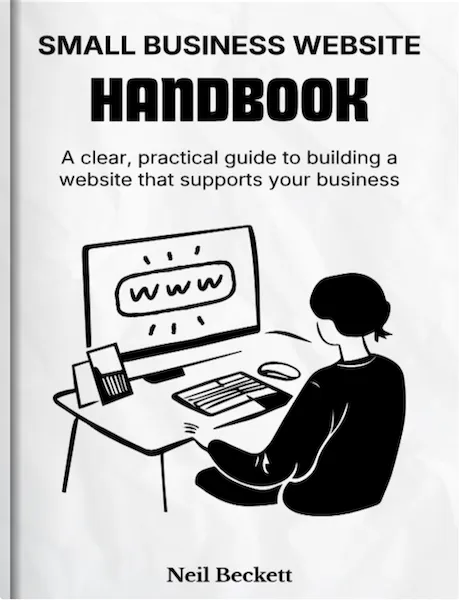
A practical resource where I explain how to think clearly about your website, so it feels easier to manage and better aligned with the way your business actually works.
Comfort with being clear, not loud
This year also required getting more comfortable with not shouting.
With explaining rather than persuading.
With clarity instead of urgency.
With trusting that the right clients recognise themselves in that tone.
That doesn’t mean being passive. It means being deliberate.
And it aligns much more closely with the kind of work I want to keep doing.
What I’m carrying forward
Looking ahead to 2026, the focus stays simple.
Continue working with clients who want their site to feel reliable again.
Continue improving existing sites rather than constantly rebuilding.
Continue explaining what’s happening in a way that makes sense to non-technical owners.
If this site feels clearer now than it did a year ago, that’s a good place to start the year.
Thanks for spending time here.