

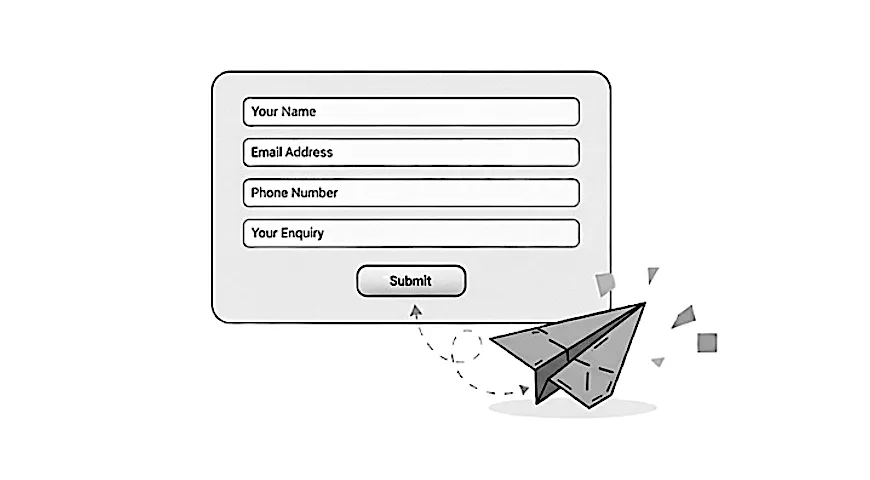
A contact form can stop sending messages without showing any obvious problem. Visitors can still fill it in, see a confirmation, and assume everything reached you. Meanwhile, nothing arrives your end. It’s a surprisingly common situation, and it often catches people off guard.
How this usually shows up
Most people first notice something is wrong when a client reaches out through another channel, or when they realise the inbox has been strangely quiet. On the website, the form behaves normally. Visitors press send, they see the confirmation message, and everything appears successful.
Because nothing looks broken, it can be difficult to know whether the form is working or not. That sense of doubt often lingers in the background. If one message didn’t arrive, it’s natural to worry that others may have vanished without a trace.
This uncertainty can build over time, especially during busier moments when enquiries matter most.
A form can look like it’s working perfectly while the messages never leave the server, which is why these issues feel so confusing.

A practical resource where I explain how to think clearly about your website, so it feels easier to manage and better aligned with the way your business actually works.
Why this happens more often than people expect
The broad reason for this issue is simple: WordPress doesn’t send emails directly. Instead, it prepares the message and hands it to the hosting environment. The host then decides whether to accept it, deliver it, delay it, or reject it entirely.
That handover may look straightforward from the outside, but it relies on several moving parts that all need to align:
- the way the contact form plugin prepares the message
- the method WordPress uses to hand it to the host
- the rules the host applies to outgoing mail
- the filtering decisions made by email providers
Any unannounced shift in these areas can cause a form to stop sending messages. Some of these changes sit beneath broader issues such as WordPress not sending emails, which is why the problem can appear suddenly even when nothing obvious has changed.
The parts that often become unstable over time
A contact form doesn’t need a dramatic failure for delivery to stop. Instead, reliability tends to slip gradually.
A few common patterns include:
- hosting environments updating their spam filtering or security rules
- plugins evolving over time, changing how messages are formed
- WordPress updates subtly altering how the message handoff works
- email providers becoming stricter about message structure
- older setups becoming fragile as everything around them becomes more modern
Individually, each change is small. Together, they can create a situation where messages are quietly dropped.
Sites that have grown or changed since they were first built are especially prone to this. What once matched the hosting environment perfectly may now be sitting on outdated settings or assumptions.
Because none of these shifts cause visible errors, the issue often stays hidden for longer than most people realise.
Email delivery rarely fails because of one dramatic change. It usually slips gradually as several small shifts start working against each other.
Misunderstandings that lead to even more confusion
A few understandable assumptions make this issue feel even more confusing.
“If the form worked yesterday, it should work today.”
Unfortunately, email delivery is influenced by many systems outside WordPress. Even if nothing on the site changed, the hosting or email provider may have updated their rules in the background.
“The confirmation message means the email was delivered.”
The on-screen message only means the form submitted successfully. It doesn’t confirm whether the email actually left the server, or whether it passed any external filters.
“It must be something I changed.”
Most delivery problems are caused by gradual shifts in the environment, not by anything the site owner did directly. Understanding these subtleties makes the situation feel much less mysterious.
The areas that often need attention behind the scenes
When delivery becomes unreliable, the underlying cause usually sits in a mix of areas that aren’t visible in the WordPress dashboard. A developer doesn’t “fix the form” so much as help stabilise the way messages move from the website to the inbox.
Typical areas that need attention include:
- the method WordPress uses to hand emails to the server
- whether the hosting environment is accepting those messages
- the structure and authenticity of the message itself
- how external email providers interpret and filter the message
- whether older parts of the setup are causing reliability gaps
These aren’t complex from the user side, but they do require a technical eye to untangle. This is a central part of how I diagnose unstable sites, because the specific adjustments depend on the hosting environment, plugin behaviour, and email provider involved. Once the handoff process becomes stable again, messages usually start flowing reliably almost immediately.
Most form issues aren’t problems with the form at all. They come from the hidden steps between WordPress, your host, and your email provider.
When you don’t need to debug this alone
Email delivery is one of the less visible parts of running a website. Several systems influence each other, and without technical feedback, it’s difficult to know where things are breaking down. There’s no simple button that confirms everything is working, which is why these issues can feel especially unclear.
A developer can look at the handover points between WordPress, the hosting environment, and the email provider, building a clear picture of where reliability has slipped. This avoids guesswork and helps ensure new messages aren’t being lost.
If you’re unsure where the problem sits, you haven’t missed anything obvious. These issues often only show up clearly with a more technical view of how messages travel.
A quick chat can save a lot of guesswork
If your form has become unreliable or messages are going missing, my Fixes and Performance service outlines how I steady things up, resolve issues like this, and restore the kind of reliability you can depend on.